

Purpose
The purpose of this quick reference guide is to step through the process of creating a General Payee Deduction record. The intended audience for this document is System Administrators / Standard Uis System Administrators / Standard Users.Steps
Create a new General Payee Deduction record
The General Payee Deduction record holds general information, Pay Code and Rates, Quantity Worked variations, Deduction Limits, Recipient details,, and Deduction Statistics for a Payee Deduction Record. Create a General Payee Deduction by following the steps belowsteps below:- Navigate to the Payee record:
- To identify a Payee record from an Employee record, enter the Employee name into the Global Search (see Figure 1).
- Select the Employee record from the suggestions provided.
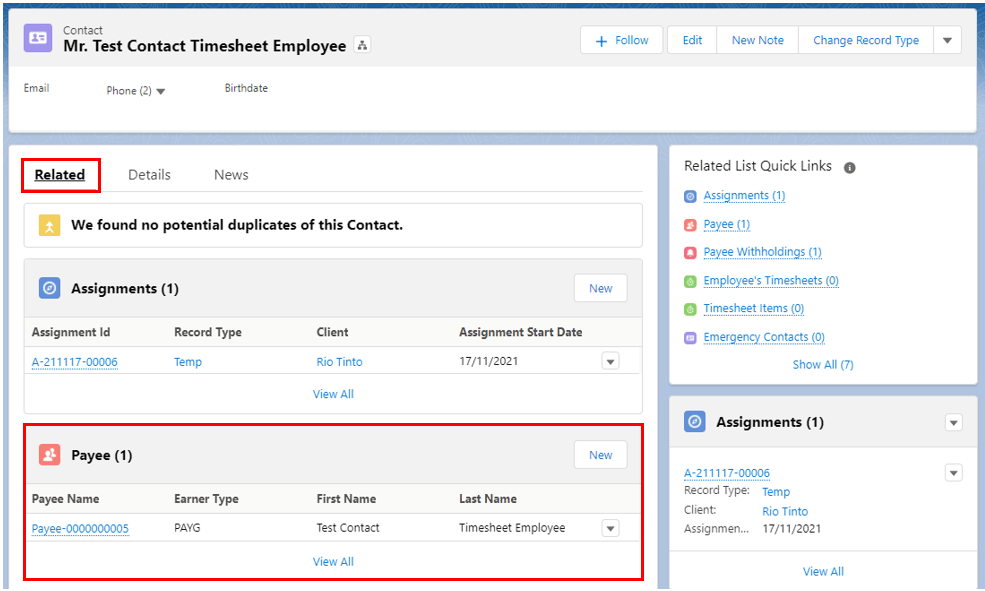
- Open the Related tab (see Figure 2).
- Identify the Payee related list.
- Select the Payee record.

- Navigate to the Payee record:
- To identify a Payee record from an Employee record, enter the Employee name into the Global Search (see Figure 1).
- Select the Employee record from the suggestions provided.
- Open the Related tab (see Figure 2).
- Identify the Payee related list.
- Select the Payee record.
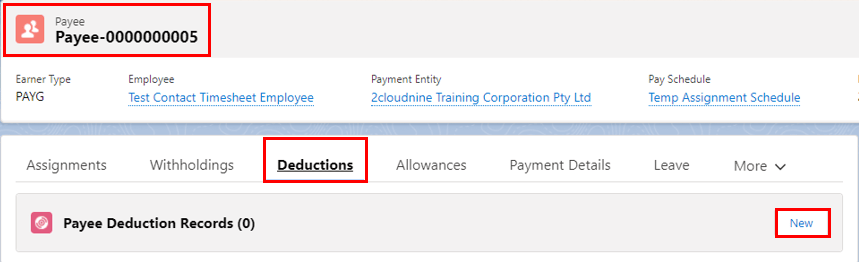
- Click Deductions from the tab options (see Figure 3).
- Click the New button.
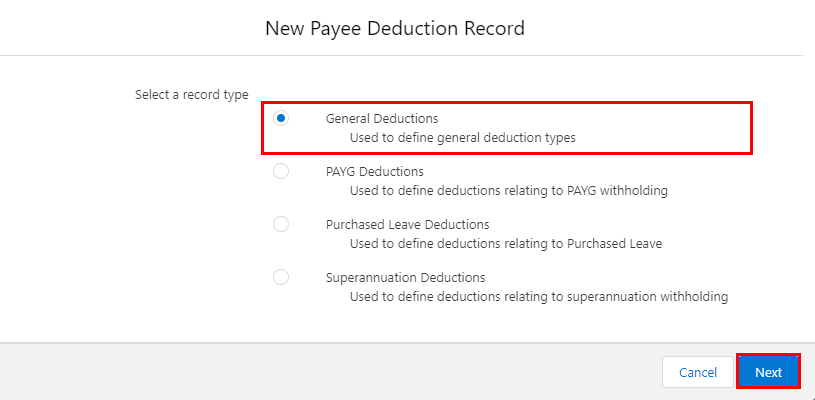
- Select General Deductions from the available record types (see Figure 4).
- Click the Next button.
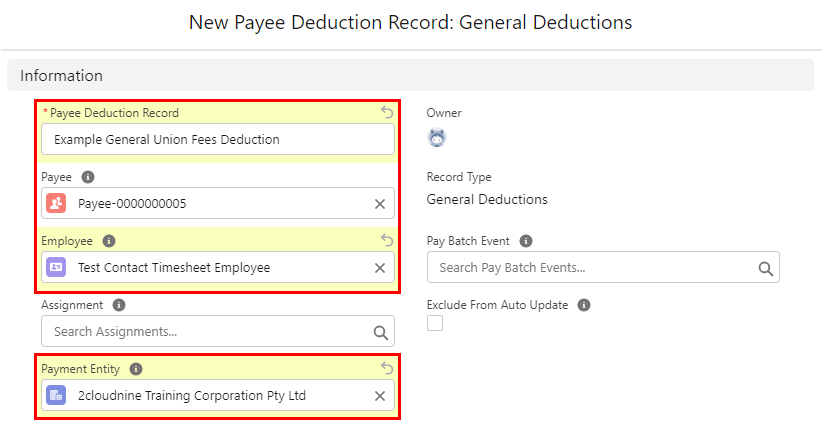
- Populate the following required fields, regardless of whether you are using Payee Deduction Templates or not (see Figure 5):
- Payee Deduction Record
- Payee
- Employee
- Payment Entity
- Populate the following optional fields as needed (see Figure 5):
- If the Payee Deduction is specific only to one Assignment, populate the Assignment field. If blank, this Payee Deduction will apply to all Assignments for this Payee.
- To prevent the Status of the Payee Deduction from being updated by the automatic status update scheduled job, populate the Exclude From Auto Update checkbox.
- Click Deductions from the tab options (see Figure 3).
- Click the New button.
- Select General Deductions from the available record types (see Figure 4).
- Click the Next button.
- Populate the following required fields, regardless of whether you are using Payee Deduction Templates or not (see Figure 5):
- Payee Deduction Record
- Payee
- Employee
- Payment Entity
- Populate the following optional fields as needed (see Figure 5):
- If the Payee Deduction is specific only to one Assignment, populate the Assignment field. If blank, this Payee Deduction will apply to all Assignments for this Payee.
- To prevent the Status of the Payee Deduction from being updated by the automatic status update scheduled job, populate the Exclude From Auto Update checkbox.
The Pay Batch Event field will be automatically populated upon saving the record, and should not be manually entered.
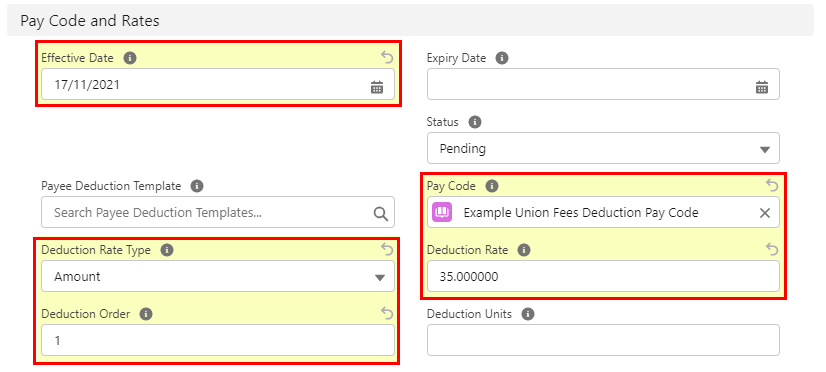
- Populate the following required fields (see Figure 6):
- Effective Date
- Status
- If using the Payee Deduction Template, the Payee Deduction Template field becomes a required field (see Figure 6).
- If the Payee Deduction Template is NOT being used, the following additional fields become required (see Figure 6):
- Pay Code
- Deduction Rate Type
- Deduction Rate
- Deduction Order
- To define any rules and limits that apply to the Payee Deduction record, populate the following optional fields as needed:
- Expiry Date
- Deduction Units
The Pay Batch Event field will be automatically populated upon saving the record, and should not be manually entered.
- Populate the following required fields (see Figure 6):
- Effective Date
- Status
- If using the Payee Deduction Template, the Payee Deduction Template field becomes a required field (see Figure 6).
- If the Payee Deduction Template is NOT being used, the following additional fields become required (see Figure 6):
- Pay Code
- Deduction Rate Type
- Deduction Rate
- Deduction Order
- To define any rules and limits that apply to the Payee Deduction record, populate the following optional fields as needed:
- Expiry Date
- Deduction Units
The Deduction Payrun Statistics will update automatically with historical statistics of the Deduction record, and should never be manually populated.
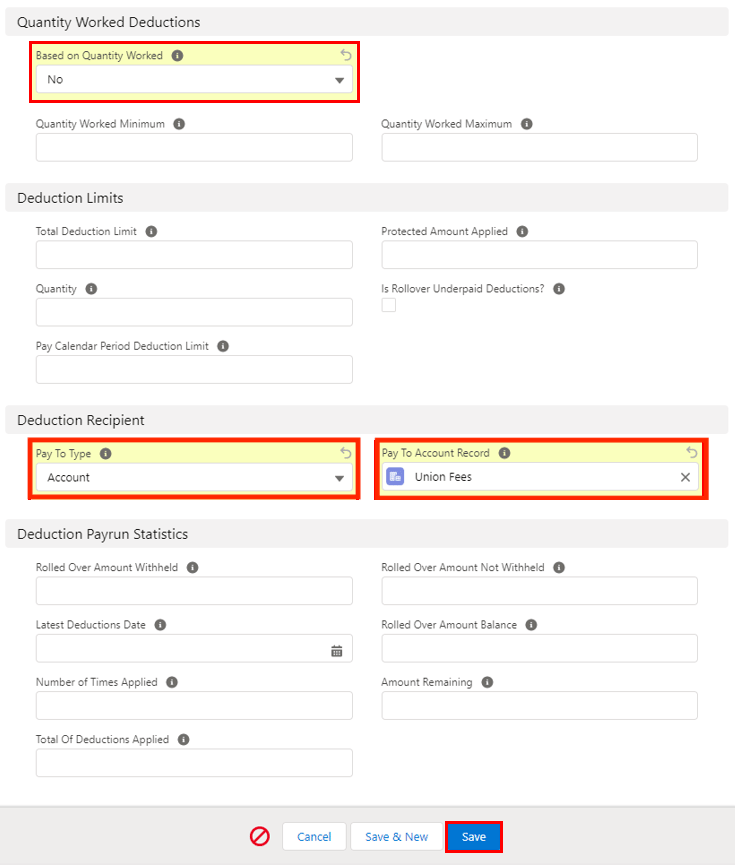
- If the Payee Deduction Template is NOT being used, the following additional fields become required (see Figure 7):
- Based on Quantity Worked
- Pay To Type (Account)
- Pay To Account Record
- To define any rules and limits that apply to the Payee Deduction record, populate the following optional fields as needed:
- Quantity Worked Minimum
- Quantity Worked Maximum
- Total Deduction Limit
- Quantity
- Pay Calendar Period Deduction Limit
- Protected Amount Applied
- Is Rollover Underpaid Deductions?
- Click the Save button.
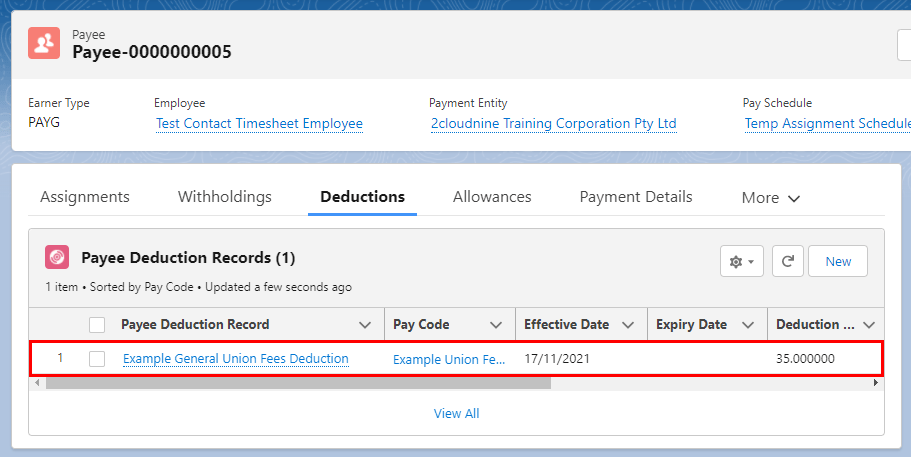
- To modify an existing Payee Deduction record, open the required record and select the Edit button available on the top right side of the page. You can also double click within fields that need editing or just click on the pencil icon that appears within fields when hovering with your cursor.
- When complete, click on the Save button.
Field Descriptions
- If the Payee Deduction Template is NOT being used, the following additional fields become required (see Figure 7):
- Based on Quantity Worked
- Pay To Type (Account)
- Pay To Account Record
- To define any rules and limits that apply to the Payee Deduction record, populate the following optional fields as needed:
- Quantity Worked Minimum
- Quantity Worked Maximum
- Total Deduction Limit
- Quantity
- Pay Calendar Period Deduction Limit
- Protected Amount Applied
- Is Rollover Underpaid Deductions?
- Click the Save button.
- To modify an existing Payee Deduction record, open the required record and select the Edit button available on the top right side of the page. You can also double click within fields that need editing or just click on the pencil icon that appears within fields when hovering with your cursor.
- When complete, click on the Save button.